Irving Caesar
Edit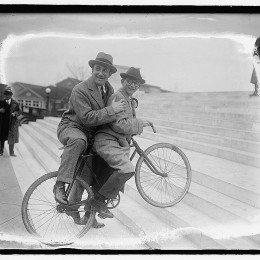 Enlarge Image
Irving Caesar was an American lyricist whose songs connected Tin Pan Alley, Broadway and popular recording. He wrote the words to Swanee with composer George Gershwin and worked with Vincent Youmans on Tea for Two. Alongside his theatrical career, he developed children's songs intended to teach safety, health and friendship.
Explore Related Biographies
Selected for this profile

People Mentioned in This Biography
Early Life and Education
Caesar was born in New York City on July 4, 1895. He attended the Chappaqua Mountain Institute and graduated from Townsend Harris Hall High School in 1914. He briefly studied at the City College of New York before going to Detroit to work for the Ford Motor Company. These early years preceded his emergence as a professional songwriter, described in American National Biography.
In 1915, he joined Henry Ford's Peace Expedition as a stenographer and secretary. The Henry Ford's finding aid for his papers preserves this part of his life through photographs, correspondence, diary material and writings about efforts to end World War I.
Swanee and Al Jolson
Caesar and Gershwin wrote Swanee in 1919. Its first theatrical presentation, in the Demi-Tasse Revue that October, attracted relatively little attention. Its fortunes changed after singer Al Jolson heard it and included it in his show Sinbad.
Jolson recorded the song for Columbia in January 1920. The Library of Congress's National Recording Registry essay describes the recording and sheet music as major successes that helped establish Gershwin's career. The recording was added to the registry in 2004. For Caesar, the collaboration became one of the best-known examples of his work as a lyricist.
Tea for Two and Broadway
Another important partnership was with composer Vincent Youmans. No, No, Nanette opened at Broadway's Globe Theatre on September 16, 1925, and ran for 321 performances. Its score included Tea for Two and I Want to Be Happy.
The Internet Broadway Database credits Youmans with the music and Caesar and Otto Harbach with the lyrics, with a book by Harbach and Frank Mandel. Caesar's broader catalogue also included Sometimes I'm Happy and Crazy Rhythm.
Children's Songs and Recognition
Caesar brought his songwriting into education through Sing a Song of Safety. Schools used the songs to introduce practical lessons about safety at home and in the street, and he performed them in school auditoriums. Related collections included Sing a Song of Friendship and Songs of Health. The friendship series addressed peace, racial tolerance and cooperation.
The Songwriters Hall of Fame inducted Caesar in 1972 and honored him with its Johnny Mercer Award in 1994. He died on December 17, 1996, aged 101. His musical legacy is also represented in the ASCAP archives acquired by the Library of Congress, which include manuscripts, lyrics, correspondence and other records from his career.
Portrait credit: Irving Caesar (right) with Con Conrad, April 17, 1924. National Photo Company Collection, Library of Congress, LC-DIG-npcc-25615; individual photographer unidentified. Original catalogue and rights advisory; Wikimedia Commons file page. Public domain (PD-National Photo Company); no known restrictions on publication. Public-domain information. Uncropped Library of Congress service image; no additional modifications.