Saddam Hussein
Edit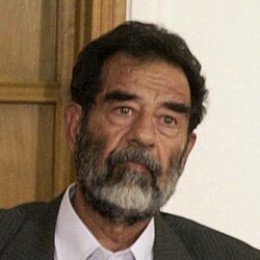 Enlarge Image
Saddam Hussein was Iraq’s president from 1979 until the overthrow of his government in 2003. A leading figure in the Ba’ath Party, he established an authoritarian state whose history included severe repression, war with Iran and the invasion of Kuwait. After his capture, an Iraqi tribunal convicted him of crimes against humanity. He was executed in 2006.
Explore Related Biographies
Selected for this profile


People Mentioned in This Biography
Early Life and Rise to Power
Hussein was born on April 28, 1937, in Al-Awja, near Tikrit, Iraq. He joined the Ba’ath Party in 1957 and participated in a failed attempt to assassinate Iraqi leader Abd al-Karim Qasim in 1959. He subsequently lived in exile before returning to Iraq. The Ba’ath Party’s seizure of power in 1968 opened the way for his rise within the government. He formally became president on July 16, 1979. Radio Free Europe/Radio Liberty’s biographical chronology traces those political milestones.
Authoritarian Rule and Human Rights Abuses
Hussein’s government used party and security institutions to suppress opposition. Its campaign against Iraq’s Kurdish population became one of the most extensively documented episodes of his rule. Human Rights Watch’s 1993 report on the Anfal campaign drew on captured Iraqi government documents and interviews with more than 350 witnesses. It documented executions, disappearances, chemical attacks, forced displacement and village destruction, concluding that the regime had committed genocide. These abuses are central to his historical record, alongside the military conflicts associated with his presidency.
The Iran–Iraq War
Iraq invaded Iran in September 1980, beginning a conflict that lasted almost eight years. The war brought extensive casualties and destruction without delivering the decisive victory Hussein had sought. A United Nations-mediated ceasefire took effect on August 20, 1988. The UN’s history of its Iran–Iraq observer mission describes the negotiations and monitoring arrangements that accompanied the end of hostilities.
Invasion of Kuwait and the Gulf War
On August 2, 1990, Iraqi forces invaded Kuwait. The United Nations Security Council condemned the invasion that same day in Resolution 660 and demanded an immediate withdrawal. The occupation led to the 1991 Gulf War, in which a U.S.-led coalition drove Iraqi forces from Kuwait.
Hussein remained in power in Baghdad after that defeat. The subsequent ceasefire framework included disarmament requirements and international monitoring. The UN’s Iraq–Kuwait mission history explains the sequence of Security Council decisions and the border-monitoring operation established after the war.
The 2003 Invasion and Capture
In March 2003, a U.S.-led invasion ordered by President George W. Bush brought down Hussein’s government. The Bush administration had argued that Iraq’s alleged weapons-of-mass-destruction capabilities posed a threat. The University of Virginia’s Miller Center history describes the inspections dispute, the ultimatum to Hussein and the military campaign. It also notes that Iraq did not use such weapons against the invading forces and that much of its earlier capability had already been dismantled.
Baghdad fell in April 2003. Hussein went into hiding and was captured by U.S. forces near Tikrit on December 13, 2003. His capture ended his period as a fugitive and led to proceedings before Iraqi authorities.
Trial, Conviction and Execution
The Iraqi High Tribunal tried Hussein over the repression that followed a 1982 assassination attempt in Dujail. He was convicted of crimes against humanity on November 5, 2006, and sentenced to death. The case concerned the killing of 148 men and boys. Hussein was executed by hanging in Baghdad on December 30, 2006, aged 69.
Human Rights Watch’s analysis of the Dujail judgment records the conviction and execution while criticizing serious procedural and evidentiary failures. The organization’s statement following the execution also notes that the separate Anfal genocide proceedings were still underway when he died. The Dujail conviction should therefore be distinguished from the broader crimes documented during his rule and the separate cases pursued against other officials.
Portrait Credit
Portrait: Staff Sgt. D. Myles Cullen, U.S. Air Force, July 1, 2004, during Hussein’s initial court appearance in Baghdad. Wikimedia Commons portrait, cropped by David Levy from the original official photograph. Public domain in the United States as a U.S. Air Force work. Existing crop resized for display.