Alessandro Manzoni
Edit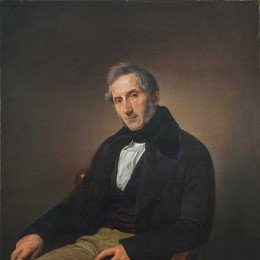 Enlarge Image
Alessandro Manzoni was an Italian novelist, poet and playwright best known for The Betrothed, or I promessi sposi. He also wrote historical tragedies, religious poetry and essays about language. His literary career became closely connected with debates about Italian national identity and the development of a shared Italian language.
Explore Related Biographies
Selected for this profile

People Mentioned in This Biography
Early life and intellectual formation
Manzoni was born in Milan on March 7, 1785. The Casa Manzoni chronology traces his schooling in religious colleges before he entered Milan's intellectual circles. In 1805 he joined his mother, Giulia Beccaria, in Paris, where he encountered French thinkers and developed a lasting friendship with the scholar Claude Fauriel.
He married Enrichetta Blondel in 1808. His return to Catholic belief around 1810 helped shape his subsequent writing. In 1813 he bought the house in Milan's Via Morone that is now associated with the museum and study center preserving his legacy.
The Betrothed and its revisions
Manzoni began the novel's first draft, then called Fermo e Lucia, in 1821 and completed it in 1823. The first published version of I promessi sposi appeared in 1827. He continued revising its language, producing the definitive illustrated edition in installments between 1840 and 1842.
The story follows two young people whose marriage is obstructed by a powerful lord. Beginning near Lake Como in 1628, it moves through a society affected by war, Spanish rule, unequal power and plague. The publisher Penguin Random House describes the novel's mixture of historical events and individual experience. Its central concern with ordinary people's lives distinguishes it from a narrative devoted solely to rulers and battles.
Poems, plays and historical writing
Manzoni's books extend beyond his major novel. His Inni sacri, or Sacred Hymns, began in 1812; four appeared in 1815, followed by La Pentecoste in 1822. His historical tragedies include Il conte di Carmagnola, published in 1820, and Adelchi, published in 1822.
Il cinque maggio, written after Napoleon's death in 1821, is among his major poems. Casa Manzoni's guide to his works documents its early circulation despite Austrian censorship. His Storia della colonna infame, issued with the final novel edition, examined injustice surrounding the seventeenth-century Milanese plague trials.
Italian language and public life
Revising The Betrothed involved a sustained investigation of how people actually spoke. As explained by linguist Silvia Morgana in Treccani's account of Manzoni's language studies, his stay in Florence in 1827 helped redirect his search toward contemporary Florentine usage. He wanted a common language that could function beyond a narrow literary audience.
Appointed a senator in 1860, he later contributed to national language policy. In 1868 he submitted Dell'unità della lingua e dei mezzi di diffonderla to education minister Emilio Broglio. His proposals favored Florentine usage as a basis for wider linguistic unity; they formed part of an ongoing debate rather than an uncontested settlement.
Death and Verdi's tribute
Manzoni died in Milan on May 22, 1873, aged 88. Giuseppe Verdi, who had visited him in 1868, honored him with the Requiem performed on the first anniversary of his death in 1874. Casa Manzoni records both the visit and the memorial connection.
His novel continues to reach readers in new editions and translations. Michael F. Moore's English translation of the 1842 text appeared in 2022, with a preface by Jhumpa Lahiri. The familiar portrait by Francesco Hayez, painted from life in 1841, is preserved at the Pinacoteca di Brera.
Portrait credit: Francesco Hayez, Portrait of Alessandro Manzoni, 1841. Pinacoteca di Brera, inventory 963. Faithful reproduction of a public-domain painting, via Wikimedia Commons. Resized Commons preview and automatic site thumbnail crop. Original portrait and reuse information. Public domain.