Dwight D. Eisenhower
Edit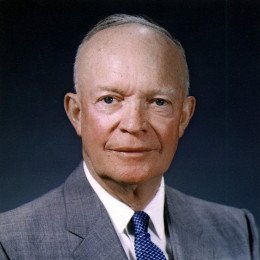 Enlarge Image
Dwight D. Eisenhower was an American Army general and the 34th president of the United States. He commanded Allied forces in western Europe during the Second World War and served two presidential terms from 1953 to 1961. His public career connected military coalition leadership with Cold War diplomacy, domestic infrastructure and federal enforcement of school integration.
Explore Related Biographies
Selected for this profile
People Mentioned in This Biography
Early life and West Point
Dwight David Eisenhower was born on October 14, 1890, in Denison, Texas, and grew up in Abilene, Kansas. The Eisenhower Presidential Library's chronology follows his life from that upbringing through military service and national office. He entered the United States Military Academy at West Point in 1911 and graduated in 1915.
He married Mamie Doud in 1916. During his early Army career, he trained soldiers, worked with tanks and held staff assignments in the United States and overseas. His official Army career account describes the influence of General Fox Conner and his later work with General Douglas MacArthur in the Philippines. These assignments developed the planning and organizational experience on which his wartime career rested.
Allied command in the Second World War
After the United States entered the war, Eisenhower worked on military planning in Washington before taking command responsibilities in Europe. He led the Allied campaign in North Africa and subsequently became the senior Allied commander responsible for the invasion of Normandy. The D-Day landings took place on June 6, 1944.
His responsibilities required coordination among the American, British and other Allied forces, as well as decisions about the timing and conduct of major operations. After the war, he served as Army chief of staff, became president of Columbia University and took command of NATO's Allied forces in Europe before entering presidential politics.
Presidency and domestic policy
Eisenhower won the 1952 presidential election as a Republican and was reelected in 1956. Richard Nixon served as vice president during both terms. The library's presidential chronology records his service from January 20, 1953, to January 20, 1961, and places events such as the 1953 Korean armistice and the establishment of NASA in 1958 within his administration.
A major domestic initiative was the interstate highway system. Eisenhower signed the Federal-Aid Highway Act of 1956, which established the financing and construction framework for a national network. The National Archives' account of the legislation explains its role in transforming transportation across the country.
In 1957, he used federal authority during the crisis over the integration of Central High School in Little Rock, Arkansas. The Eisenhower Library's civil-rights records document the decision to send federal troops and federalize the Arkansas National Guard to enforce court orders. The episode demonstrated the federal government's responsibility to uphold desegregation rulings in the face of state resistance.
Cold War diplomacy and covert intervention
The State Department's history of the period describes an administration focused on containing Soviet power and the spread of communism. Nuclear deterrence and alliances were central to that strategy. His presidency also included international crises such as Suez and the 1960 U-2 incident, which disrupted efforts at a summit with Soviet leaders.
Covert intervention was another part of his foreign policy. A published State Department editorial note reproduces Eisenhower's 1953 diary acknowledgment of the American role in overthrowing Mohammad Mosaddegh's government in Iran and restoring the shah's power. His administration combined public diplomacy with clandestine attempts to alter foreign governments.
Farewell address and later life
In his televised farewell on January 17, 1961, Eisenhower warned about the influence of the military-industrial complex. The National Archives preserves the address, which called for vigilance about the relationship between military spending, industry and democratic government.
After leaving office, he lived principally at his farm near Gettysburg, Pennsylvania, and continued writing and participating in public life. He died in Washington, D.C., on March 28, 1969, aged 78, and was buried in Abilene. His presidential library and military records preserve the different stages of a career that spanned both world war and the early Cold War.
Portrait: White House official photograph, May 29, 1959. Original file and federal-work rights record. Public domain in the United States: U.S. federal government work. Existing Commons color correction and minor blemish repair; resized preview, site resizing and thumbnail cropping.