Billy Graham
Edit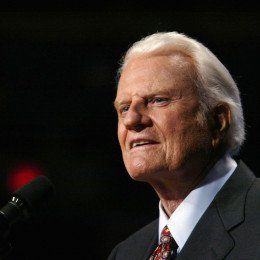 Enlarge Image
Early Life and Background
Billy Graham was born on November 7, 1918, in Charlotte, North Carolina. He was the eldest of four children in a family rooted in Christian faith; his father was a dairy farmer. Raised in a conservative Christian household, Graham committed his life to Christ during a revival meeting in 1934. This decision would profoundly shape his future as one of the most influential religious figures of the 20th century.
Quick Facts
- Birth Date
- 7 Nov, 1918
- Age
- 101 yrs
- Occupations
- Theologian
Autobiographer
Cleric
Show all facts
- Citizenship
- United States of America
- Birth Place
- Charlotte
- Education
- Wheaton College
Bob Jones University
Trinity College - Gender
- Male
- Description
- American Christian evangelist
- Spouse
- Ruth Graham[1943-2007]
- Net Worth 2021
- 25 million
Explore Related Biographies
Selected for this profile


People Mentioned in This Biography

Rise as an Evangelist
Billy Graham became an ordained Southern Baptist minister and gained international recognition as a leading American evangelist. His first major crusade in Los Angeles in 1949 catapulted him to national prominence. Graham’s ministry soon expanded globally through his organization, the Billy Graham Evangelistic Association (BGEA), founded in 1950. He was notably one of the earliest evangelists to embrace mass media, using radio, television, and, later, the internet to reach audiences worldwide.
Global Impact and Preaching Reach
Graham held large-scale indoor and outdoor evangelistic rallies, known as "crusades," around the world. According to the Billy Graham Evangelistic Association, he preached to live audiences numbering more than 210 million people in over 185 countries and territories. Estimates suggest his total lifetime audience, including radio and TV broadcasts, reached more than two billion people. This made him one of the most widely heard Christian evangelists in history.
Influence on Politics and Society
Graham served as a spiritual advisor to every U.S. president from Harry S. Truman to Barack Obama, earning him considerable influence in American political and spiritual life. He often advised leaders on moral and religious issues but maintained a nonpartisan stance in political matters. His counsel was sought during critical moments in American history, including the Civil Rights Movement and periods of national crisis.
Civil Rights and Social Contributions
Throughout his ministry, Graham took several steps toward promoting racial equality. In the 1950s and 1960s, he insisted on racially integrated seating at his crusades, defying segregation norms of the time. While his role in the Civil Rights Movement was not as prominent as that of other leaders, he used his platform to advocate for unity and inclusion, opposing racial discrimination in both word and action.