Francis Crick
Edit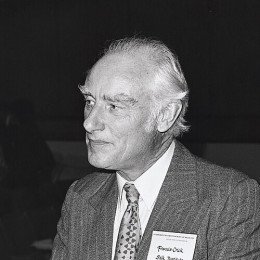 Enlarge Image
Francis Crick was a British molecular biologist, biophysicist and neuroscientist best known for proposing the double-helical structure of DNA with James Watson in 1953. His later work addressed the genetic code, protein synthesis and the biological basis of consciousness. He shared the 1962 Nobel Prize in Physiology or Medicine with Watson and Maurice Wilkins.
Explore Related Biographies
Selected for this profile

People Mentioned in This Biography
Early life, physics and wartime research
Francis Harry Compton Crick was born in Northampton, England, on June 8, 1916. He studied physics at University College London, completing his bachelor's degree in 1937. His first attempt at doctoral research was interrupted by the Second World War.
The Nobel Foundation's biographical account, written around the time of his award, describes wartime work for the British Admiralty on magnetic and acoustic mines. After leaving that work in 1947, he turned toward biology. He joined the Medical Research Council unit at Cambridge's Cavendish Laboratory in 1949 and later completed a Cambridge doctorate on X-ray diffraction and protein structure in 1954.
DNA and the double-helix model
Crick met Watson at Cambridge in 1951. Their partnership brought together different scientific backgrounds and a shared interest in the structure of genetic material. In 1953 they proposed a model in which DNA's two chains formed a double helix. The arrangement also suggested a way in which genetic information could be copied.
The model drew on experimental work conducted elsewhere, including X-ray diffraction studies by Rosalind Franklin and Wilkins at King's College London. King's history of the discovery places the Cambridge model alongside the experimental research: the April 1953 issue of Nature carried separate papers by Watson and Crick, by Wilkins and colleagues, and by Franklin and Raymond Gosling. This was the elucidation of DNA's structure, rather than the first identification of DNA as a substance.
The genetic code and protein synthesis
Crick's scientific career extended well beyond the double helix. He investigated how genetic information could specify proteins, developing theoretical ideas and working with Sydney Brenner on the genetic code. The International Union of Crystallography's account identifies protein synthesis, the adaptor hypothesis and experiments with mutations among the major directions of his work.
In 1962, Crick and Brenner took joint charge of the Molecular Genetics Division at the new Laboratory of Molecular Biology in Cambridge. His research combined mathematical and structural reasoning with close attention to experiments, helping connect questions about molecules to questions about heredity and cellular function.
Neuroscience, books and later life
Crick began working at the Salk Institute in California in 1976 and took a permanent position there in 1977. He moved into theoretical neurobiology and research on consciousness, including work with Christoph Koch. The Wellcome archive catalogue documents this transition through correspondence, notebooks and scientific papers, distinguishing it from his earlier DNA and genetic-code research.
His books included What Mad Pursuit: A Personal View of Scientific Discovery in 1988 and The Astonishing Hypothesis in 1994. He also served as Salk's president in 1994–95. The institute's memorial biography records his death on July 28, 2004, aged 88. His surviving papers preserve both the development of molecular biology and his later attempt to make consciousness a subject of biological investigation.
Portrait credit: Unknown photographer, Francis Crick at a scientific symposium at Stanford University School of Medicine, 1980. Wellcome Images, via Wikimedia Commons. CC BY 4.0. Resized Commons preview and automatic site thumbnail crop. Original portrait and reuse information. CC BY 4.0.