Rosalind Franklin
Edit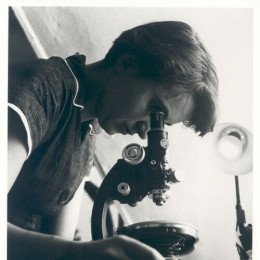 Enlarge Image
Rosalind Franklin was a British chemist and X-ray crystallographer whose research helped establish the molecular structure of DNA. Her scientific work also encompassed coal, graphite and viruses. She is closely associated with Photograph 51, produced with her research student Raymond Gosling at King's College London in 1952, but her career reached far beyond that single image.
Explore Related Biographies
Selected for this profile

People Mentioned in This Biography
Early life and scientific education
Rosalind Elsie Franklin was born in London on July 25, 1920. She attended St Paul's Girls' School and studied natural sciences at Newnham College, Cambridge. The English Heritage account places her education within the development of her interest in molecular chemistry and biology.
During the Second World War she joined the British Coal Utilisation Research Association in 1942. She investigated the physical structure and porosity of coal, research relevant to fuel performance and materials used in gas masks. She received a Cambridge doctorate in 1945. Historian Patricia Fara's biography for the Rosalind Franklin Institute emphasizes the importance of this early work alongside her better-known DNA studies.
Paris, King's College and Photograph 51
After the war, Franklin worked in Paris with Jacques Mering, developing expertise in X-ray techniques for investigating materials. She applied those methods to coals and graphite before taking up a research fellowship at King's College London in 1951.
At King's she examined DNA fibres under different conditions of hydration, distinguishing the A and B forms. Photograph 51 showed the diffraction pattern of the wetter B form. In his account of the experiment, molecular biophysicist Brian Sutton records that Franklin and Gosling exposed the sample to X-rays for 62 hours in May 1952. The striking pattern represented demanding experimental work and analysis, not a conventional photograph of a visible molecule.
DNA research and recognition
The image and Franklin's measurements helped inform the double-helix model proposed by James Watson and Francis Crick at Cambridge in 1953. King's institutional biography states that Maurice Wilkins showed the photograph to Watson without Franklin's agreement or knowledge. Franklin and Gosling's experimental paper appeared in the same issue of Nature as the model paper.
Her interpretation of the evidence continues to receive scholarly attention. In an October 2026 account of new archival research, King's described Alistair Sponsel and Brian Sutton's finding that Photograph 51 was a deliberately improved version of Photograph 49. Franklin had already extracted information about helical structure from the earlier image. The researchers distinguished that insight from establishing the molecule's exact number of strands at that stage.
Virus research at Birkbeck
Franklin moved to Birkbeck College in 1953, working in J. D. Bernal's laboratory and collaborating with Aaron Klug. Her group investigated the structure of viruses, particularly tobacco mosaic virus. This work applied her experience with X-ray diffraction to another major biological problem and helped establish structural virology.
The university named in her honor documents her research on coal, DNA and viruses, presenting a broader record than the familiar Photograph 51 narrative. She continued scientific work while seriously ill and died on April 16, 1958, aged 37. The 1962 Nobel Prize for the DNA discovery was awarded to Watson, Crick and Wilkins four years after her death. Her reputation rests on a substantial experimental career as well as her contribution to the DNA story.
Portrait credit: MRC Laboratory of Molecular Biology, Rosalind Franklin with a microscope, 1955; personal collection of Jenifer Glynn, via Wikimedia Commons. CC BY-SA 4.0. Resized Commons preview and automatic site thumbnail crop. This adapted photograph is available under the same license. Original portrait and reuse information. CC BY-SA 4.0.