Olivia de Havilland
Edit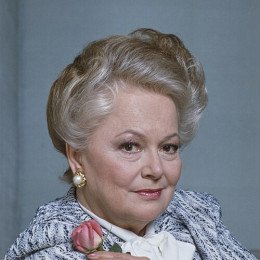 Enlarge Image
Olivia de Havilland was a British-American actress known for Gone with the Wind, The Adventures of Robin Hood and two Academy Award-winning leading performances. Her career also included a successful challenge to Warner Bros.' interpretation of her studio contract. She moved from romantic adventure films to demanding dramatic roles and later worked in television.
Explore Related Biographies
Selected for this profile
People Mentioned in This Biography
Early Life and Education
De Havilland was born in Tokyo, Japan, on July 1, 1916, to British parents. She grew up in California, where school and community theatre gave her early opportunities to perform. Her younger sister also became a film actress, using the professional name Joan Fontaine.
According to the National Endowment for the Arts biography, she graduated with honors from Los Gatos High School in spring 1934 and received a scholarship to study drama at Mills College. Instead, an opportunity with Max Reinhardt changed her plans. She understudied Hermia in his production of A Midsummer Night's Dream and played the role at its Hollywood Bowl opening that September. She subsequently appeared as Hermia in the 1935 film adaptation.
Warner Bros. and Early Film Success
At Warner Bros., de Havilland became a familiar screen partner of Errol Flynn. Their adventure films included Captain Blood (1935), The Charge of the Light Brigade (1936) and The Adventures of Robin Hood (1938). The Academy of Achievement's biography and interview describe this partnership and her wish to move beyond roles defined chiefly by the leading man's story.
She also played Angela in Anthony Adverse (1936), a film based on Hervey Allen's bestselling novel. The AFI catalogue identifies her character and the adaptation's source. Her performance as Melanie Hamilton in Gone with the Wind (1939) brought a Supporting Actress Oscar nomination and became one of her most enduring screen roles.
The 1944 Studio-Contract Decision
De Havilland sought greater choice over her work, refusing some assignments she considered unsuitable. Warner Bros. suspended her and claimed that the suspended time could be added to her contract. In August 1943, she brought an action seeking a declaration that the agreement had ended.
The California Court of Appeal's December 8, 1944 opinion held that the studio could not enforce the contract beyond seven calendar years from the commencement of her services. Suspension periods did not extend that statutory limit. The decision, commonly associated with her name, became a significant precedent in the history of Hollywood employment. It gave her career a lasting place in discussions of performers' independence as well as acting.
Academy Awards and Dramatic Roles
Her postwar work fulfilled the ambition to take on more varied characters. She won Best Actress for To Each His Own (1946) at the 1947 Academy Awards. In that film, she played a woman whose life is shaped by the loss of her child through adoption.
She received another nomination for The Snake Pit (1948), portraying a woman undergoing psychiatric treatment. Her second Best Actress Oscar came for The Heiress (1949), as recorded by the 1950 ceremony's official results. Directed by William Wyler and adapted from Henry James's Washington Square, the film gave her the role of Catherine Sloper, a wealthy young woman confronting her father's judgment and a suitor's intentions.
Later Career, Honors and Death
De Havilland settled in Paris and wrote the humorous book Every Frenchman Has One, published in 1962. Her later screen work included Lady in a Cage and Hush…Hush, Sweet Charlotte (both 1964). She also appeared in television productions, receiving a 1987 Supporting Actress Emmy nomination for Anastasia: The Mystery of Anna, according to the Television Academy.
She received the National Medal of Arts in 2008. De Havilland died in Paris on July 26, 2020, aged 104. The National Archives' memorial confirms the date and recalls her contributions to cinema.
Portrait credit: Bernard Gotfryd, February 1985. Library of Congress, Prints & Photographs Division, Bernard Gotfryd Collection, LC-DIG-gtfy-01097. Commons PD-Gotfryd; Library of Congress reports no known copyright restrictions after the photographer’s lifetime. Existing Commons crop (3% horizontal, 12% vertical) and resized derivative; no further retouching. Wikimedia Commons file and history. Library of Congress rights statement.