Barry Goldwater
Edit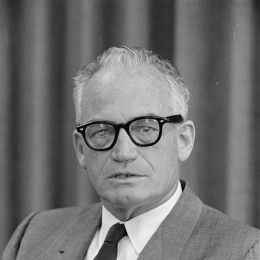 Enlarge Image
Barry Morris Goldwater was an American politician, aviator and photographer who represented Arizona in the U.S. Senate for five terms and became the Republican presidential nominee in 1964. His defeat by Lyndon B. Johnson was decisive, but his campaign and writing helped strengthen the conservative movement within the Republican Party. He later returned to the Senate and played prominent roles in defense and intelligence oversight.
Explore Related Biographies
Selected for this profile
People Mentioned in This Biography
Early life and education
Goldwater was born in Phoenix on January 1, 1909, when Arizona was still a territory. He attended Staunton Military Academy in Virginia and enrolled at the University of Arizona. He left university after his father's death in 1929 to work in the family's department-store business, eventually becoming its president and chairman. Arizona State University's guide to his personal and political papers traces that transition from student to businessman and public figure.
His interests extended beyond retailing. He experimented with radio, flew aircraft and photographed Arizona's landscapes and Native American communities. During World War II he served as a military pilot, and his subsequent reserve career brought him to the rank of major general. The Goldwater Scholarship Foundation's biography describes aviation, electronics and photography as lasting pursuits throughout his life.
From Phoenix to the Senate
Goldwater won a seat on the Phoenix City Council in 1949. In 1952 he defeated Democratic senator Ernest McFarland, then the Senate majority leader, and entered the Senate in January 1953. Reelected in 1958, he served until January 1965. He did not run for Senate reelection while pursuing the presidency in 1964. The Civil Rights Digital Library's congressional biography distinguishes this first period of service from his later return.
Goldwater advocated a limited federal government, private property and a strong anticommunist foreign policy. His 1960 book The Conscience of a Conservative, written with speechwriter Brent Bozell, gave those positions a wider audience. The Senate Historical Office identifies the book as an important statement in the development of modern American conservatism. Its subjects included government power, labor relations, civil rights and the welfare state.
The 1964 presidential campaign
Goldwater won the Republican nomination after a contest that exposed deep disagreements between the party's conservative and moderate wings. His supporters welcomed a clear ideological alternative; opponents portrayed him as dangerously extreme, particularly on nuclear war. The election therefore concerned both policy and competing visions of the Republican Party.
Civil rights formed a central part of that record. Goldwater voted against the Civil Rights Act of 1964 and against the motion to end the Senate filibuster. The Library of Congress exhibition documents his opposition and civil-rights leader Roy Wilkins' response to his campaign rhetoric. That vote remains a significant part of assessing his political legacy.
In November, Johnson won 486 electoral votes to Goldwater's 52, according to the National Archives' official electoral results. Goldwater carried Arizona and five Southern states. The loss ended his presidential bid but did not end his political career or the conservative organizing associated with it.
Return to Washington and defense reform
Elected again in 1968, Goldwater served in the Senate from January 1969 until January 1987. He chaired the Intelligence Committee and, later, the Armed Services Committee. During Watergate, he joined Hugh Scott and John Rhodes in an August 1974 meeting with Richard Nixon about the president's deteriorating congressional support. The Ford Library's Watergate chronology places that meeting immediately before Nixon announced his resignation.
As Armed Services chairman, Goldwater worked with colleagues across party lines on military reorganization. The National Archives' committee history describes his role in advancing the Goldwater-Nichols Act of 1986. This institutional work was another important part of a career often remembered primarily for the 1964 campaign.
Retirement and legacy
Goldwater did not seek reelection in 1986. Congress established the scholarship program bearing his name to support students preparing for research careers in science, engineering and mathematics. His photographic and personal papers also preserve his interests in Arizona and technology. He died on May 29, 1998, aged 89. His legacy combines influence on conservatism, a contested civil-rights record and decades of congressional service.
Portrait credit
Photo: Marion S. Trikosko, September 25, 1962, Library of Congress collection via Wikimedia Commons. Public domain. Existing Commons crop; downloaded Commons 960px resized derivative. No further image editing before upload. Bijog may resize the image and crop thumbnails.